Financial technologies are transforming the financial world through innovation and technological progress, reshaping traditional financial services from the ground up. World FinTech Day is an ideal occasion to celebrate this transformation.
To highlight the latest developments, challenges, and opportunities in the sector, Octet Türkiye hosted the first Octet World FinTech Day Webinar on August 1. In our previous blog post, we explained World FinTech Day in detail and why it is celebrated on August 1.
Related content: August 1 World FinTech Day: The Perfect Convergence of Finance and Technology
In this article, we share the key takeaways from the Octet World FinTech Day webinar, where leading voices discussed the rise of artificial intelligence in fintech and the future of next generation banking.
Octet World FinTech Day Webinar: When Did It Take Place?
August 1 is celebrated globally as World FinTech Day, marking the date when Cosimo de Medici, widely regarded as an architect of modern banking and the founder of the first banking system, passed away in 1464.
Octet, a fintech company providing online supply chain payment solutions for intercompany trade since 2017, organized an online event on this special day to inform finance professionals, academics, entrepreneurs, and the wider public about the current state of financial technologies.
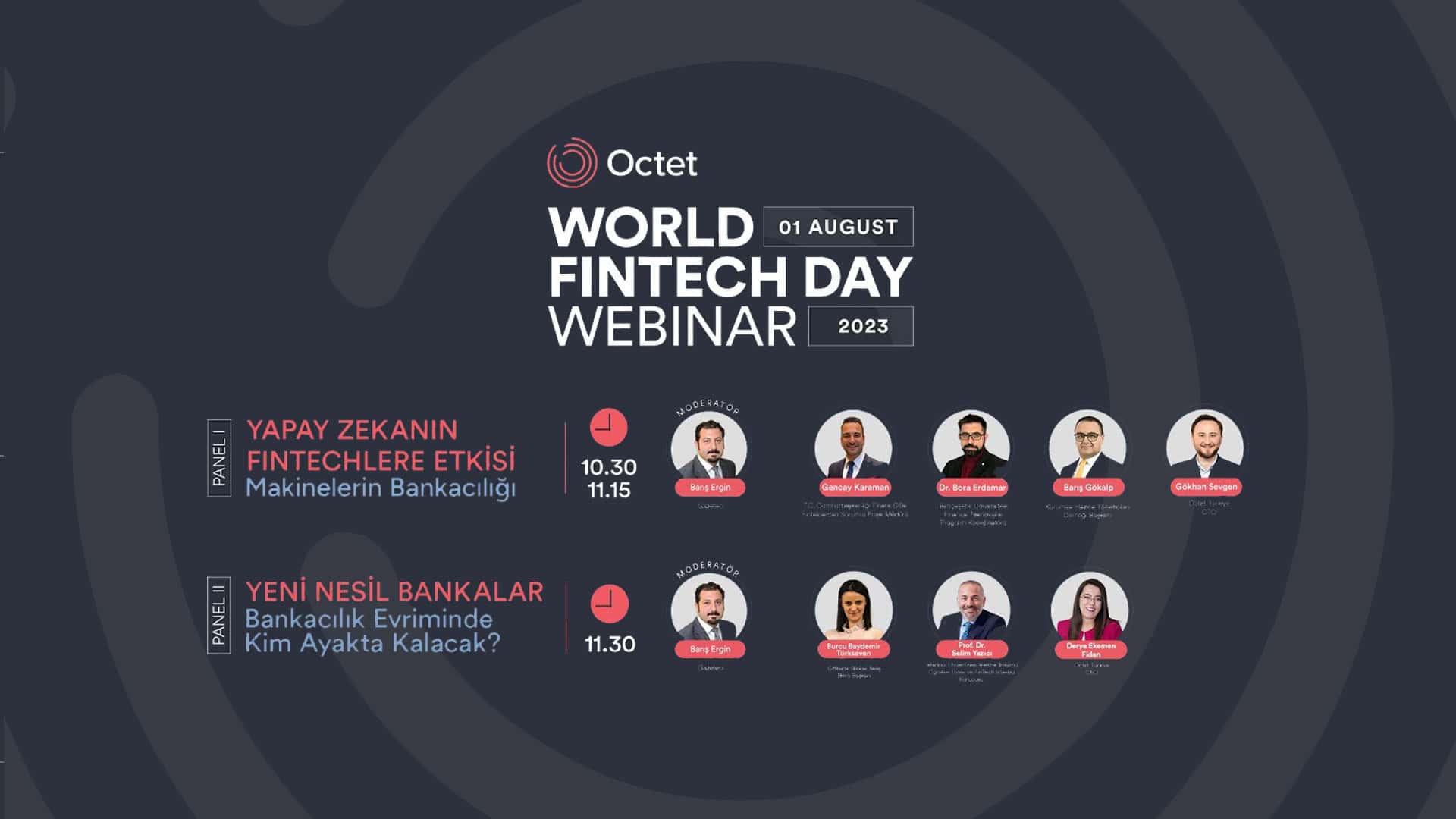
The Octet World FinTech Day Webinar was broadcast live simultaneously on YouTube and LinkedIn on Tuesday, August 1, 2023.
What Was Discussed at the Octet World FinTech Day Webinar? Who Participated?
With the main theme “The Evolution of Banking and the Rise of Artificial Intelligence,” the webinar took place in two panels moderated by journalist Barış Ergin.
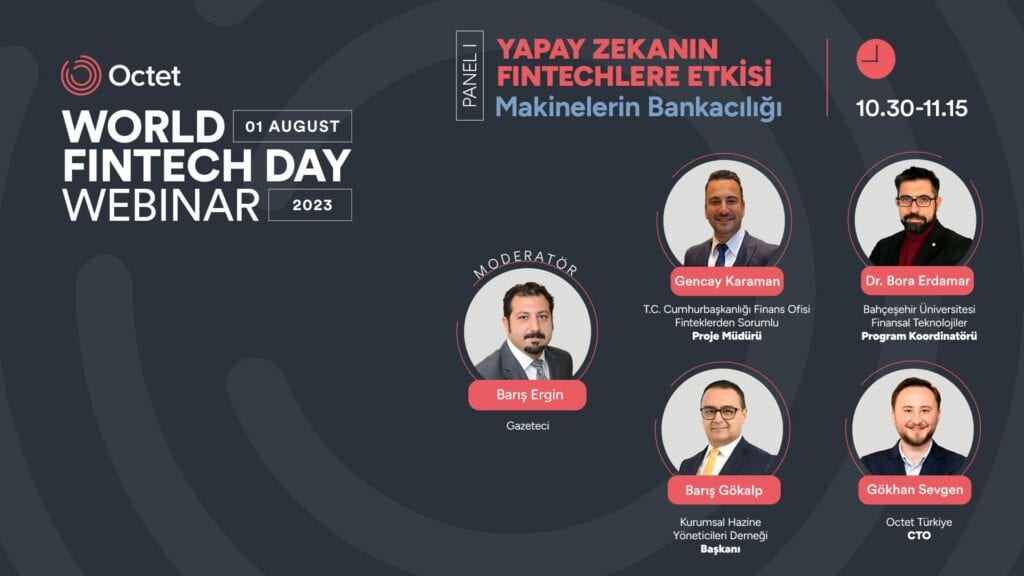
Panel 1 Participants: The Impact of Artificial Intelligence on FinTech
- Gencay Karaman, Project Manager Responsible for FinTech, Republic of Türkiye Presidency Finance Office
- Bora Erdamar, Program Coordinator, Financial Technologies, Bahçeşehir University, Founding Director, BlockchainIST Center
- Barış Gökalp, President, Corporate Treasury Managers Association
- Gökhan Sevgen, CTO, Octet Türkiye
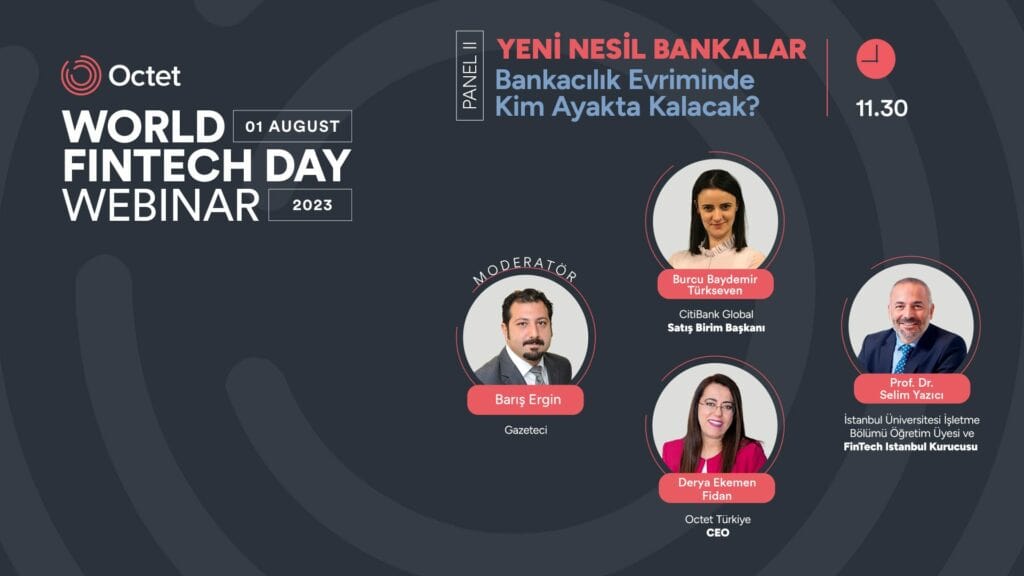
Panel 2 Participants: Next Generation Banks: Who Will Survive the Evolution of Banking?
- Burcu Baydemir Türkseven, Head of Global Transaction Banking Sales, Citibank
- Dr. Selim Yazıcı, Faculty Member, Istanbul University School of Business, Founder of FinTech Istanbul
- Derya Ekemen Fidan, CEO, Octet Türkiye
What Were the Key Topics Discussed at the Webinar?
Panel 1: The Impact of Artificial Intelligence on FinTech
In the first panel, the discussion focused on the rapid rise of AI in fintech and the foundational requirements for creating scalable, trustworthy innovation. Key themes included the introduction of “Bilge,” the AI interface referenced during the session, the importance of investing in talent, the role of high quality data, and AI based scoring models.
Highlights from Gencay Karaman
Gencay Karaman emphasized that the Presidency Finance Office aims to position Türkiye among the leading countries in financial technologies. He noted that the office supports the fintech ecosystem in the adoption and use of artificial intelligence and referenced “Bilge” as an AI interface supporting ongoing work, including monthly publications and sector resources.
He also pointed to upcoming initiatives, including plans for a regulatory testing environment under the oversight of relevant authorities, often referred to internationally as a regulatory sandbox. He further stated that steps have been taken toward fintech focused structures within Istanbul Financial Center, and that the development stage of a national fintech hub concept is progressing, with further details to be shared publicly.
He also referenced ecosystem size figures, noting that Türkiye has hundreds of fintech companies across key verticals such as payments, banking technologies, and crypto assets and blockchain, and highlighted AI’s contribution to advances in areas such as risk assessment, fraud detection, and customer service.
Highlights from Dr. Bora Erdamar
Dr. Bora Erdamar underlined the strategic importance of building human capital in emerging technologies and creating environments where talent can learn, produce, and commercialize ideas quickly. He emphasized that new technology toolsets enable faster experimentation and product development than ever before, including in highly complex projects such as national digital currency initiatives.
He also argued that because risks may not be fully understood in early phases, collaborative testing environments involving public institutions, academia, and possibly private sector partners can be highly beneficial.
Highlights from Barış Gökalp
Barış Gökalp emphasized that with clean and structured internal data, machine learning can support forward looking cash flow insights, enabling businesses to anticipate liquidity needs months in advance. He stressed that the real multiplier effect comes from combining high quality data with qualified talent capable of building the right analytical models.
He also noted that automation of manual processes benefits both funding providers and beneficiaries, and that AI will become increasingly important for liquidity management and working capital solutions.
Highlights from Gökhan Sevgen
Gökhan Sevgen highlighted that as the fintech sector grows, companies are expanding beyond a single financial product and launching multiple financing solutions. He emphasized the importance of encouraging businesses to adopt technology and using expanding datasets to develop stronger decision algorithms.
He noted that as the ecosystem grows and data becomes more anonymized at scale, decision making mechanisms can become more powerful. He also referenced ongoing efforts to strengthen existing products with AI, particularly in scoring and fraud prevention, and mentioned work to incorporate a broader set of data types into scoring approaches.
Panel 2: Next Generation Banks: Who Will Survive the Evolution of Banking?
The second panel explored the evolving relationship between fintech and traditional banking, as well as topics such as financial literacy, the role of SMEs in the economy, open banking, and organizational agility.
Highlights from Burcu Baydemir Türkseven
Burcu Baydemir Türkseven stated that conventional banks continue to support fintech through multiple channels, including venture initiatives. She described the fintech and banking journey in three phases: bank digitization, fintech delivery of banking services, and the current era where the combined value of fintech and banking ecosystems is becoming the most important focus.
She emphasized the importance of creating a structure in which customers, fintech players, banks, and regulators all benefit, and noted that regulations may meet current needs but will naturally evolve as systems mature and adoption grows.
Highlights from Prof. Dr. Selim Yazıcı
Prof. Dr. Selim Yazıcı emphasized that digital banking strategies must be built around a deep understanding of society, technology, economics, and regulation. He noted that customer behavior, cultural structure, spending and saving habits, and financial literacy should all shape the value proposition of digital banks.
He also highlighted that while digital adoption is strong, there remains a meaningful segment that still prefers branches. In this context, he argued that differentiation depends on the unique value delivered compared to traditional banks.
He further emphasized the economic importance of SMEs and stated that digital banking should help SMEs manage cash more easily, reduce paperwork burdens, and enable secure, easy access to banking and collections products so SMEs can focus on their core business and growth.
Highlights from Derya Ekemen Fidan
Derya Ekemen Fidan described open banking as a major game changer and noted that regulatory developments in recent years have accelerated fintech growth, encouraged banking digitization, and supported open banking expansion.
She emphasized that the key challenge is developing solutions that help banks operate more agilely while also reducing process time for companies and making cash management easier. She added that for corporate users, payments and collections are often the top priority.
She also described Octet’s direction toward a unified experience where customers can view transactions on a single screen and initiate open banking actions such as payment initiation and account viewing, with the overarching goal of enabling more efficient working capital management in a way that is easy to adopt and apply.
What Should You Do If You Missed the Webinar?
The Octet World FinTech Day Webinar was broadcast live on Tuesday, August 1, 2023 on YouTube and LinkedIn. If you missed it, you can watch the full recording via the Octet Türkiye YouTube channel.
Related content: Octet World FinTech Day Webinar